www.1814mag.com
1814 MAGAZINE is a limited edition, bi annual publication that focuses on photography, design, art, and culture.
1814 MAGAZINE is dedicated to providing a unique platform for established and emerging artists.
1814 MAGAZINE strives to combine the best in both words and images from some of the greatest photographers and artists of the 20th and 21st century. Recent issues have included such celebrated artists as E.O. Hoppe, Massimo Vitali, Eudora Welty, Bernard Faucon, Donna DeMari, Karlheinz Weinberger as well as Henry Horenstein, Wang Qinsong, Vivian Maier, Georges Dambier, Christer Stromholm, Edward Ruscha, Yves Marchand & Romaine Meffre, Antony Armstrong Jones, Paulina Otylie Surys, Chris Stein, Mel Roberts, and Alexander Gronsky. Known for its clean gallery type presentation and unusual juxtapositions, 1814 MAGAZINE both mirrors and encourages the evolution of photography, art and culture.
Revolution - Punk, Hip Hop, and Street Culture - Photographs and Words by Janette Beckman
www.1814mag.com
Artek - A Summer In The Crimea - Photographs by Claudine Doury - Words By Christian Cajolle
www.1814mag.com
1814 MAGAZINE Issue no. 8
Cover: Grace Jones by Jean-Paul Goude
www.1814mag.com
Surrealized - Fabricating Reality - Photographs by Angus McBean - Words by Snowdon
He's an amazingly sensitive and kind man, who wanted to make people look their best, look beautiful. That is something which has now, sadly, been changing and for which I am partly responsible. But he is kind and that shows through his lens; he is incapable of taking an ugly picture. Any idiot can put a mugshot down on celluloid. Only Angus and a few other people, like Irving Penn, can do it with such dignity…' - Snowdon
www.1814mag.com
Honky Tonk - Three Chords and the Truth - Photographs and Words by Henry Horenstein from his book 'Honky Tonk'
www.1814mag.com
So Goude - Muse, Spectacle, and the French Correction - Photographs, Collage and Illustration by Jean-Paul Goude - Interview with Jean-Paul Goude by Séverine Harzo
JPG: I have always liked to work with girls. When I was a teenager, I was systematically attracted by girls who had style, the ones who fixed themselves up better than the others, and I'd go as far as advising them on what they should wear or not. Much later when I arrived in New York, I went on doing the same thing, this time with Toukie Smith, with whom I lived and whose close cropped Masai inspired hair style represented to me the the only alternative to those elaborate pompadour hair styles that were so popular with women of color in the late 60's. All this to say that Toukie was the perfect incarnation of African American femininity. Same thing with the shape of black women's bodies, whose long legs and generous backsides I chose to celebrate by exaggerating them. In 1973 I made a reduced version from a cast of Toukie that I judged not dramatic enough. Cutting up the twelve inch statue into pieces, I elongated its legs, arms, neck, and considerably exaggerated its posterior: but my Toukie doll was a flop. Toukie hated it.
Grace Jones, on the other hand, was very receptive to my ideas. I think thats what she liked about me…
www.1814mag.com
For The Love Of God's Country - The Inertia of the American dream - Photographs by Brian M. Cassidy
Lethe or lethe - (n) a river in the Greek underworld that made souls forget the sufferings of life; oblivion or something to make you enter oblivion and forget - Photographs by Paulina Otylie Surys - Fashion by Robert Marc
(n) a river in the Greek underworld that made souls forget the sufferings of life; oblivion or something to make you enter oblivion and forget
www.1814mag.com
I Woke Up In My Clothes - Photographs by Aaron Stern from his book 'I Woke Up In My Clothes' - Words by David Wagoner
Don't do it, the guidebook says
if you're lost. Then it goes on
to talk about something else,
taking the easiest way out,
which is of course what water does
as a matter of course always
taking whatever turn
the earth has told it to
while and since it was born,
including flowing over
the edge of a waterfall
or simply disappearing
underground for a long dark time
before it appears
as a spring so far away
from where you thought you were
and where you think you are
it may never occur
to you to imagine where
that could be as you go downhill.
- David Wagoner www.1814mag.com
1814 MAGAZINE Issue no. 7
www.1814mag.com
Qajar - Sanandaj, Iranian Kurdistan, 1870's - Recently discovered glass plates by various photographers - Courtesy of Newsha Tavakolian Collection - Interview with Newsha Tavakolian
NT: These photographs were taken during the Qajar era in Iran which is around 110 - 130 years ago. It was during this period that the camera was first introduced to Iran by a Russian Ambassador who gave one as a gift to the King, Nasser al-Din Shah. It was only the very rich who were privileged enough to own a camera.
1814: What can you tell us about the photographers?
NT: Some of these photographs were taken by Ismael Kahn, my cousin's grandfather. He was probably around 16 years old at the time and had fallen in love with photography after meeting a famous Russian photographer named Antoine Sevruguin. Kahn's father had hired this photographer to come to work for them…
www.1814mag.com
The Brilliance Of Blumenfeld - Photographs by Erwin Blumenfeld - Interview with Nadia Blumenfeld-Charbit
NBC: Cecil Beaton, who was already a successful Vogue photographer at the time, happened to notice portraits of the daughters of Marie-Laure de Noailles that Blumenfeld had made, and asked to see his other works. Impressed by Blumenfeld's talent, he introduced him to Michel de Brunhoff, Editor In Chief at Vogue Paris, who gave him his first commissions. In his correspondence, Beaton finds Blumenfeld far to gifted artistically for fashion photography and atrociously ugly! They remained lifelong friends…
www.1814mag.com
Impersonating Mao - Iconography and Illusion - Photographs by Nathalie Daoust
www.1814mag.com
The Holloway Road - Photographs by James Loveday
Candidates - Candidates in the French Presidential Election 2012 - Photographs by Pascal Fellonneau
www.1814mag.com
Joan Of Art - Joan Quinn Captured - Works by Various Artists - Words by Laura Whitcomb - Courtesy of the Joan & Jack Quinn Collection
www.1814mag.com
R & B - Documenting the frenzy and beauty of music… - Photographs by Bruce Talamon from his forthcoming book - Words by Bruce Talamon
www.1814mag.com
Main Street - Photographs by Fred Herzog - Interview with Fred Herzog by Allison V. Smith - Courtesy of Equinox Gallery, Vancouver
FH: …Pender Street is the main artery of so-called Chinatown in Vancouver. It is one of the largest Chinatown's in North America and comprises about 15 city blocks. In my opinion, Vancouver's Chinatown was its biggest attraction and an endless source of photographic possibilities. This has not changed. While most of the city has been modernized, this area has generally been left alone.
www.1814mag.com
Fire Island Pines - Polaroids 1975 ~ 1983 - Photographs and Words by Tom Bianchi from his book Fire Island Pines
www.1814mag.com
1814 MAGAZINE Issue no. 6
1814 MAGAZINE Issue no. 6 includes the work of Fredrik Broden, Ellen Rogers, Bernard Faucon, Cristina de Middel, Edward Ruscha, Dominik Guillemot, Elena Capra, Chris Stein, Anne Lass, Karlheinz Weinberger, Charles Moriarty, and Lisa Guerriero.1814 MAGAZINE Issue no. 6 cover photograph of Debbie Harry by Chris Stein
www.1814mag.com
Oneiric - Of or relating to dreams - Words by Rosemarie Short - Photographs by Ellen Rogers
Summer Camp - 1976 ~ 1981 - Words and Photographs by Bernard Faucon - From the books 'Les Grandes Vacances' and 'Summer Camp by Bernard Faucon
"The idea of fabricating fictions, the idea of a possible equation between photography and the dummies, struck me quite out of the blue. Childhoods made of flesh and plaster, the many lights of Luberon, the nostalgia and actuality of desires, crystallized together through the magical operation of the photographic record. The power fix, externalized in light, attest to the world the perfection on an instant…" - Bernard Fauconwww.1814mag.com
Mind Space - Blank canvas, base camp, incubator - Photographs by Dominick Guillemot
"When my Dad, a fashion photographer, told me he was taking photographs of my high school friends in their bedrooms I have to admit I was surprised. In these very private worlds I wasn't sure what he would find or if I wanted him to see what was happening, not necessarily because there was anything to hide but rather because he would know them as I do. Our bedrooms attempt separation. They are a space to express ourselves without being watched, apart from all the parental input and ideally where we can be alone with our own output. They can be a canvas or a base camp, but whatever they may be, our bedroom is our place." - Theo Guillemotwww.1814mag.com
Picture This - An intimate view of the 70's and 80's Punk and New Wave music scene - Words and Photographs by Chris Stein
Anya is wearing an original Malcom McLaren and Vivian Westwood 'bone rock shirt'… They have one at the Met and one in a frame on Kings Road in the Vivian Westwood boutique." - Chris Stein www.1814mag.com
Triple 7 - Examining the casinos and gambling dens of Berlin - Photographs by Anne Lass
The gambling dens of Berlin look very different. Many of them are improvised and are not meant to exist particularly long. Anne Lass has photographed these places without gamblers and gambling machines to underline the puzzling atmosphere that she thinks pervades the suspect places. The puzzling element is intensified by symbolic references to the gambling world, running through the gambling dens, a combination of tarot and magic, religion, natural phenomena and space, all of it helping the gambler achieve success and wealth… www.1814mag.comHalbstark - 'Half Strong' - Photographs by Karlheinz Weinberger from the book 'Rebel Youth' by Karlheinz Weinberger - Interview with Patrik Schedler
1814: What were Karlheinz' early interests and what circumstances lead to his interest in photography?P.S.: "As a boy he loved to draw, to make nice books with poems, self made, and copied, which were illustrated. He had a strong eye for graphics, but he was not the guy who's going to paint a picture on a canvas. That was something for the 'better'. I believe that unconsciously he understood photography as a modern, revolutionary, and also socialist media of art…" - Patrik Schedler www.1814mag.com
Before Frank - Amy Winehouse, New York, 2003 - Photographs by Charles Moriarty
"Nothing was written down and the only advice I was given was, 'make it look like London at night'. But we were in New York, I thought 'ARE YOU Mental'. Amy arrived where I was staying for one night and our task was to shoot the inlay for Frank.We waited for night to come, and with it came an enormous thunder and lightning storm, so we waited, but eventually at 3:00 a.m. we gave up, the images seen here are the result of the following morning when we knew we needed to do something different, I'm pretty sure this is the very first time Amy ever did her beehive for camera.
These images reflect a side of Amy I believe many have never seen, she was 19 and still recording for the release of her first album Frank. I knew Amy would be a great success, I just never knew the road ahead would be so tumultuous…" - Charles Moriarty www.1814mag.com
The Oliver Twins - Walter & David Oliver - Photographs by Lisa Guerriero
"We lived together until we were 19 years old. Then we both enlisted in the army and were stationed in Germany. They wouldn't keep us in the same unit. We brought back beer mugs from Germany, they served beer in a crystal mug back then… used to cost me 25 cents a mug back then, now it's $3.50. In 1957 I bought my Rolleiflex in Germany. I wanted a Leica but bought the Rolleiflex because it was 2.25…" - David Oliverwww.1814mag.com
1814 MAGAZINE Issue no.5
1814 MAGAZINE Issue no. 5 includes the work of John Carder Bush, Brandon Long, Christer Stromholm, Mehryl Levisse, Charles Moriarty, Lee Roach, Rafal Maleszyk, Sonja Kranz, Simon Norfolk, Colette Lumiere, Serge Lutens, Vivian Maier, Donna DeMari and Alexander Gronsky.1814 MAGAZINE Issue no. 5 cover by Christer Stromholm
www.1814mag.com
Cathy - Early images of Kate Bush from the book 'Cathy' 1986, by John Carder Bush - Photographs and words by John Carder Bush
JCB: When the child has found herself the posture and strength, and there is a feeling of permanence. But it is always like that when an octave is complete. And waiting to start the next is adolescence. Changing is, at best, uncomfortable but the same process has to be gone through to make the teenager stronger that made the child able to look into the lens with such expression. And the music was coming out...www.1814mag.com
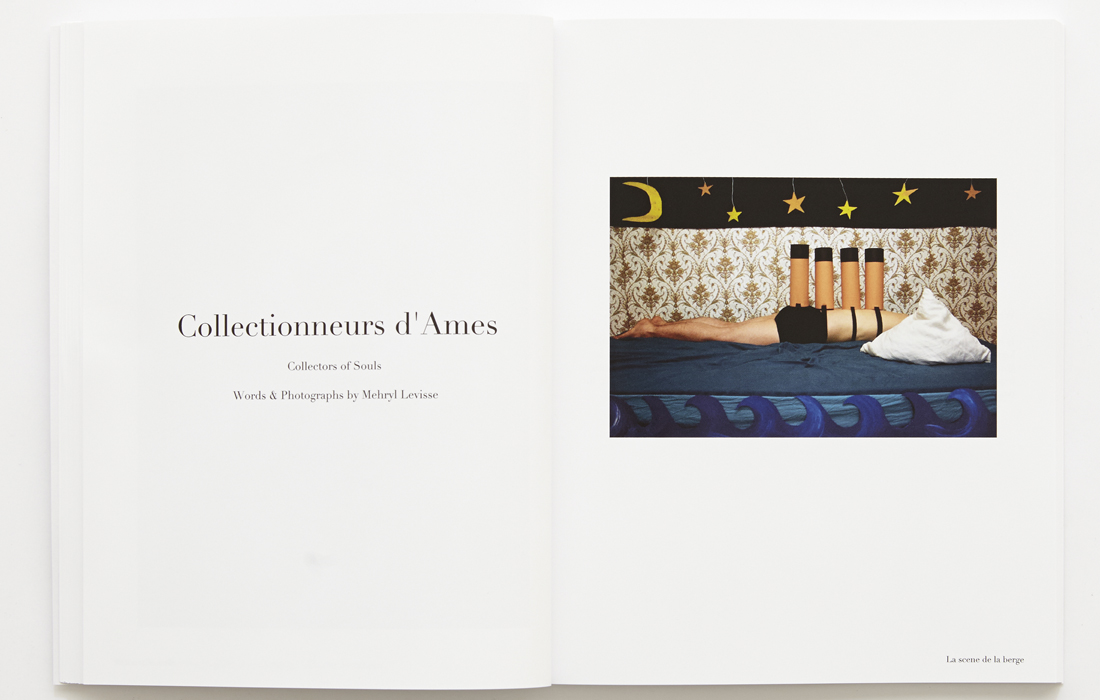
Collectionneurs d'Ames - Collectors of Souls - Words & Photographs by Mehryl Levisse
ML: Who said the body is a finished thing?www.1814mag.com
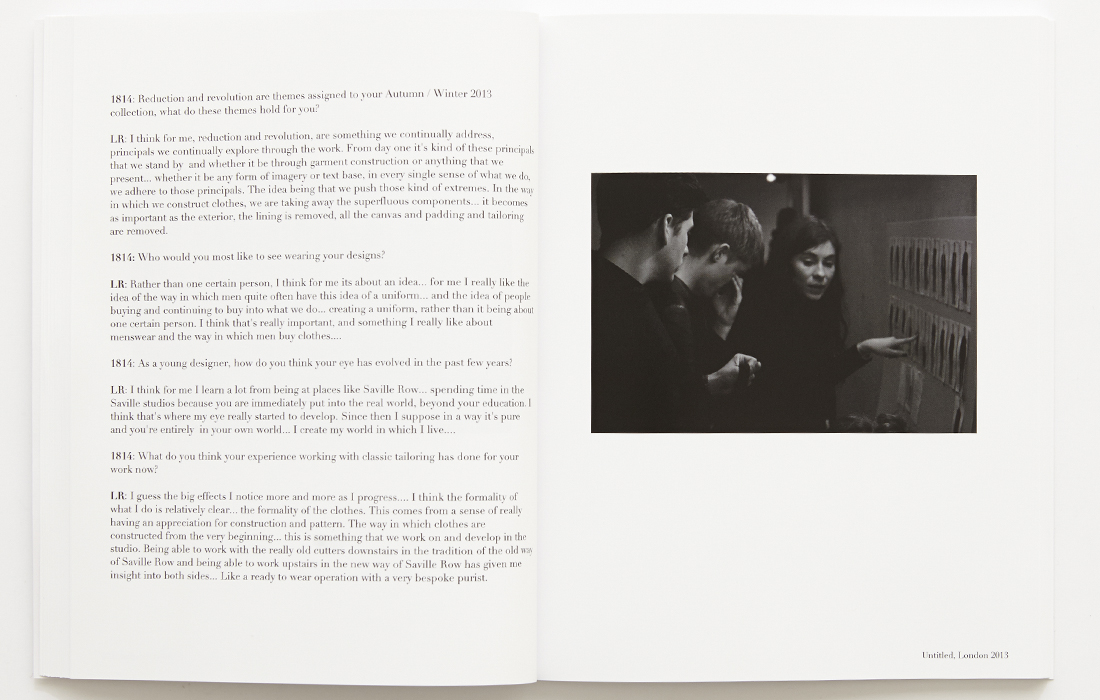
Reduction & Revolution - An interview with designer Lee Roach - Photographs by Charles Moriarty - Interview by Daniel Gaines
1814: Reduction and revolution are themes assigned to your Autumn Winter 2013 collection. What do these themes hold for you?LR: I think for me, reduction and revolution, are something we continually address, principals we continually explore through the work. From day one it's kind of these principals that we stand by and whether it be through garment construction or anything that we present... whether it be any form of imagery or text base, in every single sense of what we do, we adhere to those principals. The idea of being that we push those kind of extremes. In the way in which we construct clothes, we are taking away the superfluous components... it becomes as important as the exterior, the lining is removed, all the canvas and padding and tailoring are removed...
www.1814mag.com
Landscapes In Plastic - Photographs by Rafal Maleszyk
RM: Plastic is omnipresent, pollution cannot be sustained. This project is a metaphor for the disrespect of nature by people. It is an original idea of changing the landscape by incorporating the proper kinds of plastic...www.1814mag.com
The Spirit Of Inquiry - Seeing the Large Hadron Collider - Photographs by Simon Norfolk
SN: Seeing the Large Hadron Collider at the CERN laboratory in Switzerland, I was amazed that it resembled the view one has bending one's neck back and looking up into the cupola of an English cathedral, or the domes of the mosques I once photographed in Isfahan or Istanbul. In vast, columned chambers, the blades of the LHC were being assembled in an atmosphere of methodical, industrial piety. But when I made the final prints of the pictures, They seemed to resemble crop circles or Tibetan mandalas. One of the disks is even fronted by a massive, stonehenge-like trilithon...www.1814mag.com